About · The Photographer
A biologist
who photographs.
In that order.
Ossian Reyes spent his twenties counting seabirds on wind-blown Hebridean islands before anyone paid him for a photograph. The conservation biology came first and it has never left: every frame he makes is built on reading a territory until the animals stop performing — and on the certainty that a photograph earned by disturbing an animal isn’t worth making.
Fifteen years on, the archive runs to 40,000 frames across 38 countries, from Arctic fox dens in Svalbard to hornbills at 34 metres in Borneo’s canopy. He works on editorial and conservation commission, sells limited-edition prints, and leads four small-group expeditions a year — six photographers, never more.
The Pledge
Ethical fieldcraft,
published in full.
Every commission, print and expedition runs under these five rules. They are not marketing; they are the conditions under which the work gets made — and the reason the animals in it look the way they do: completely themselves.
01
Never bait, never call in, never lure.
No playback, no food, no scents, no captive or habituated-to-feeding animals presented as wild. Ever.
02
The animal’s behaviour outranks the frame.
If my presence changes what the animal does — feeding, resting, fleeing — I move back or I move on.
03
Distances are the animal’s to set.
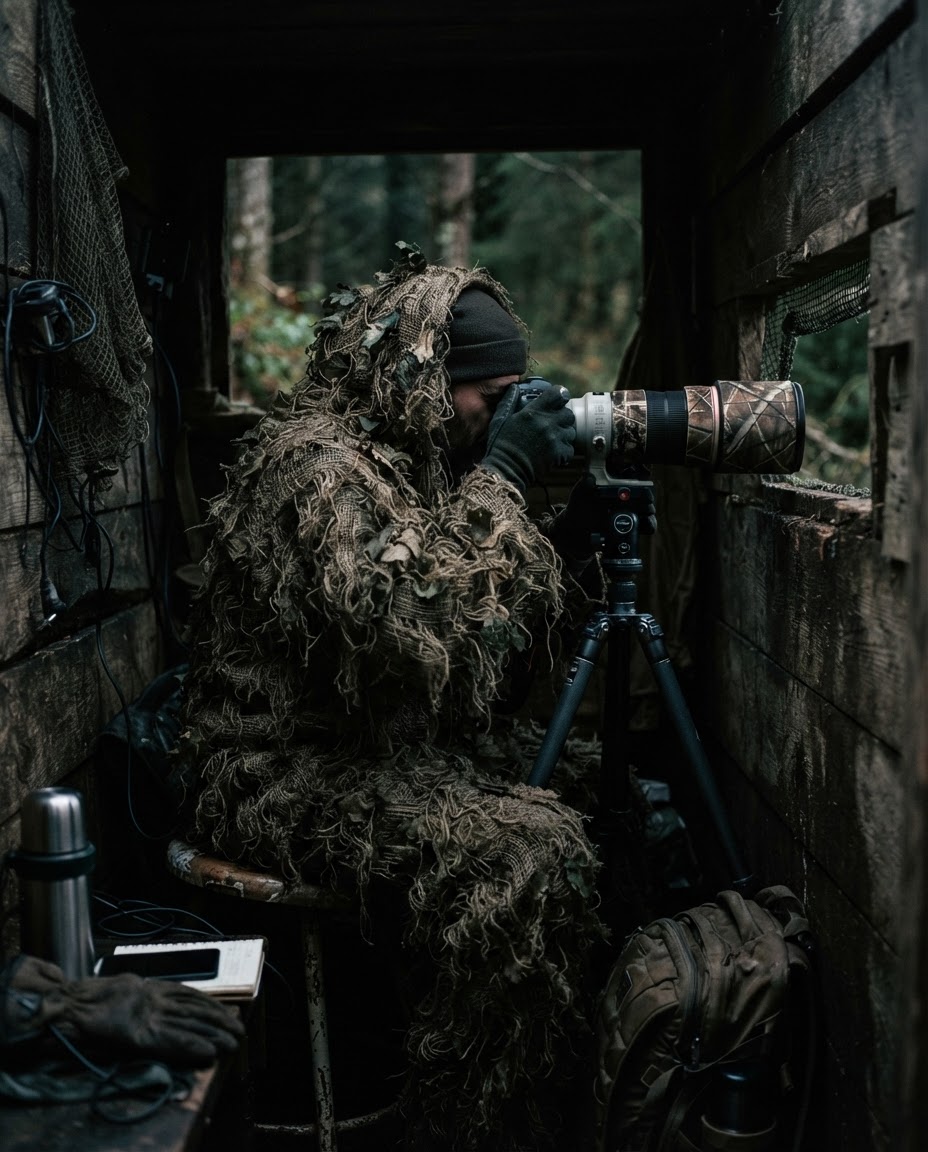
Long glass, ground hides and weeks of habituation do the work that approaching would ruin.
04
No frame is worth a habitat.
No off-road driving, no vegetation cleared for a sightline, no nest or den exposed for a shot. Location data stays protected.
05
The work gives back.
A share of every print and expedition fee goes to the conservation trust working in that territory.
The Long Way Round · 2011 — 2026
Fifteen years,
told in hide hours.
2011
BSc Conservation Biology, then two seasons surveying seabirds in the Hebrides. Camera bought to document nests; never really put down.
2014
First commission: a winter series on pine martens for a Scottish conservation trust. 61 hide hours for one published frame.
2018
Danum Valley, Borneo. The fig-tree frame and the start of the canopy work that would define the next decade.
2022
BBC Wildlife Photographer of the Year, commended. First solo exhibition, "The Wait", in Bristol.
2024
National Geographic Traveller portfolio feature. The ethical-fieldcraft pledge published in full, adopted by two expedition operators.
2026
40,000 frames in the archive, 38 countries, one rule never broken. Expeditions 2027 open for booking.
Featured in & awarded by
- BBC Wildlife · Photographer of the Year, Commended 2023
- National Geographic Traveller · Portfolio Feature, 2024
- Wildlife Photographer of the Year · Finalist, Animal Portraits 2022
- The Guardian · "The Patience School" interview, 2024
- Audubon · Photo Essay: Canopy Kings, 2023
- Outdoor Photographer · Cover Story, Winter 2025
- Conservation Photography Award · Gold, 2024
- Smithsonian · "Forty-One Hours in a Hide" feature, 2025
“The best photograph is usually
the one you almost walked away from.”
Ossian Reyes · Field journal, Svalbard, 2024