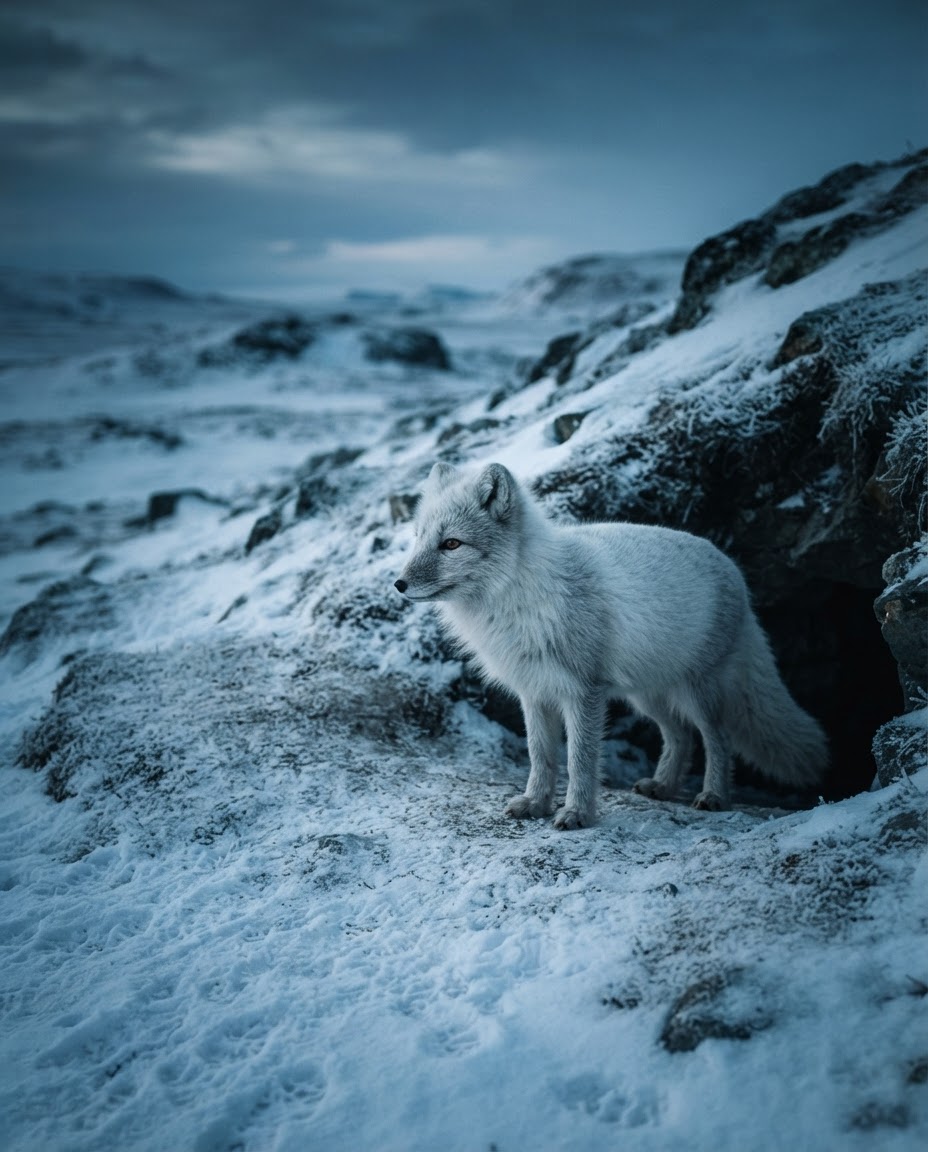
The trench was dug on the first evening, eleven metres from the den mouth, in snow that had to be cut with a saw and carried away by hand so no fresh scent line pointed at me. Then it was a matter of settling in: sleeping bag, thermos, two camera bodies, a pee bottle nobody talks about but everybody needs, and four days of Arctic silence — forty-one of those hours without once climbing out.
The arithmetic of the wait
People assume wildlife photography is about luck. It isn’t. It’s arithmetic. If an animal uses a place honestly — den, drinking hole, hunting fence line — then time spent there compounds. Hour four teaches you nothing. Hour twenty teaches you the rhythm: when the vixen leaves, which way the wind has to blow for her to relax, how the light moves across the snow shelf above the entrance.
By hour forty-one I had stopped composing photographs and started composing behaviour. I knew the exact minute the low sun would strike the den mouth, and I knew she’d be sitting there a few minutes before it did, because the rock beside the entrance holds warmth.
The frame I almost walked away from
On the third night the temperature dropped to −27°C and my shutter hand stopped working properly. The rational move — the move my conservation-biology training kept suggesting — was to pack out, warm up, come back in better conditions. I stayed, because leaving felt like breaking an appointment.
The next evening she came out eleven minutes before the light. Sat exactly where the warmth was. Looked at something behind me that I will never see, and the whole den, the whole fjord, the whole four days of frozen waiting resolved into a single vertical frame at 1/800th of a second.
Hours in the hide: 96 across four days — 41 of them unbroken. Attempts: 4. Final frame: one.
What the fox decided
Here is the part that matters, and it’s the reason the ethical-fieldcraft pledge exists at all. She never once looked at me. Not once in four days. That is not because I was clever; it is because the trench was dug before she needed the den that week, because I never moved at dawn when she was listening, and because eleven metres is a distance that lets a fox be a fox rather than a subject.
The photograph is good. But the fact that her winter was completely unchanged by my presence — that is the part I’m proud of. Every frame on this site is held to the same standard: never bait, never disturb, and if the choice is ever between the animal’s calm and my shutter, the animal wins. Every time.
— O.R., written in Longyearbyen airport, waiting for a delayed flight and better weather than the one I left.