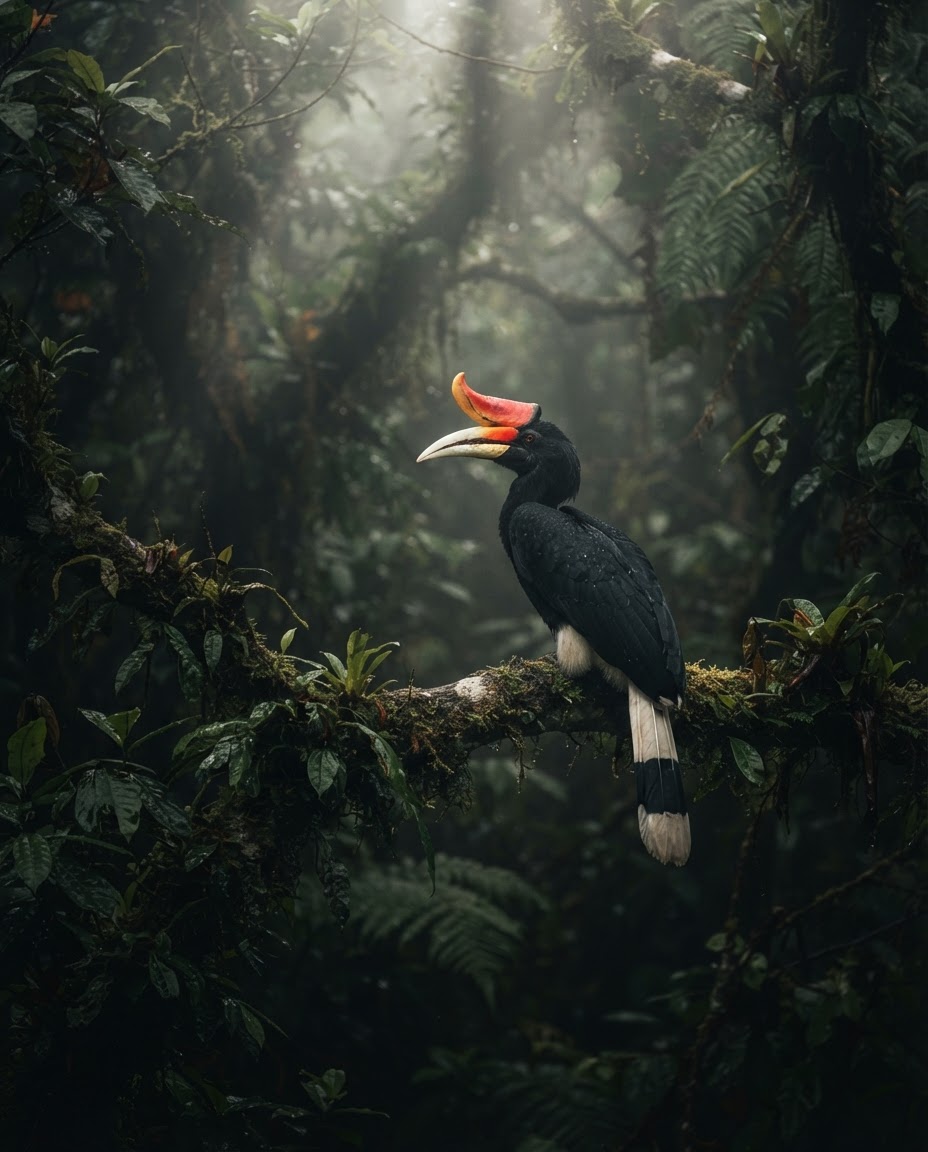
A rhinoceros hornbill does not pose. It arrives when the figs are ready, strips the tree in a matter of days, and leaves the canopy quieter than it found it. My job, across two wet seasons, was to be inside that window without being of it.
Building a hide in the sky
The platform went up over three days with the help of two Danum Valley field assistants and a great deal of rope: a metre-square frame lashed into a neighbouring tree at 34 metres, level with the fruiting fig, wrapped in canvas and cut foliage. We built it in the wet season on purpose — the rain covers noise, and hornbills habituate to a structure that appears gradually and smells of nothing but forest.
Every morning began at 04:15 with the climb. Head torch off for the last ten metres. Then eight hours of not moving very much, in a climate that turns a camera strap into a wet rope and a lens into a small aquarium if you breathe on it wrong.
The shaft of light
The frame I wanted was specific and, honestly, a little ridiculous: the bird on the mossy branch, backlit by a single shaft of morning sun coming through a gap in the canopy, mist still sitting below us. That light exists for perhaps nine minutes a day, on clear-ish mornings, when the mist is exactly low enough.
Season one: the light came twice. The bird came once, on the wrong branch. Season two: I stopped photographing the bird and started photographing the conditions — logging mist heights, wind direction, fruit ripeness, in a notebook that now reads like the field journal of a slightly obsessive ornithologist. Which is exactly what a conservation biologist turned photographer turns out to be.
Hour 184
The morning it happened, I knew by 05:30 that it was possible: mist at the right level, gap in the cloud where the sun would come, figs at peak. He arrived at 06:41, worked along the branch toward me, and for about four seconds sat exactly inside the shaft.
Hours in the hide: 184. Attempts: 7. Final frame: 1/500th of a second, and the photograph that put me in National Geographic Traveller the following year.
The rule the canopy taught me
Up there you learn that the forest does not know you exist, and that this is precisely the point. The hornbill’s visit to the fig was identical in every way to the visits it made before I ever tied a rope to a branch — that was the standard I was working to. Not “did I get the shot” but “would the shot have happened, exactly like this, without me.”
If it wouldn’t, I don’t take it. The canopy is very good at making that test feel personal.
— O.R., Danum Valley field station, by generator light.