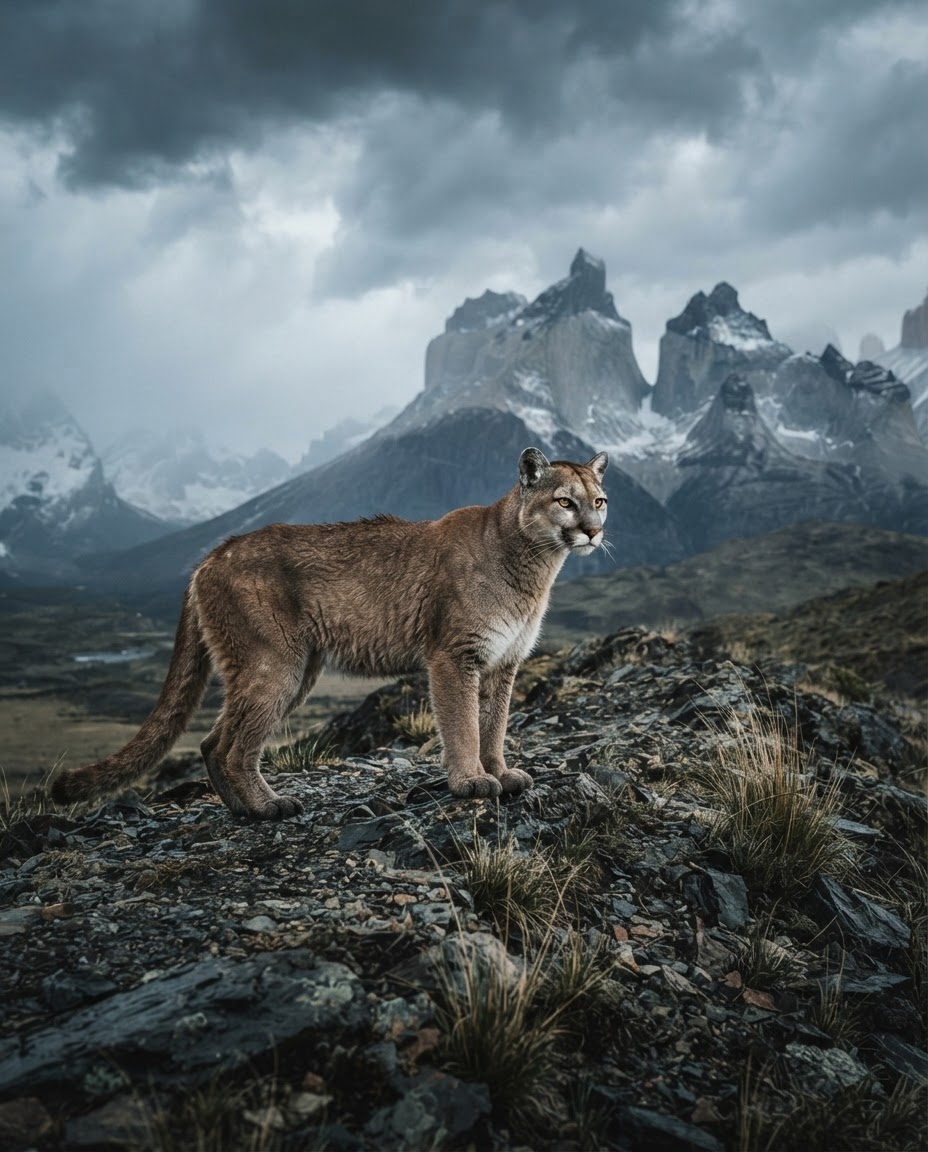
Patagonia in winter is an argument you usually lose. The wind arrives before sunrise, holds 80 km/h until dusk, and treats tripods, patience and body heat as personal insults. And yet it has the best puma light on earth — hard, low, silver-edged — and a population of cats that live their whole lives in the open, on the steppe, where you can watch behaviour instead of guessing at it.
Learning one territory, slowly
I’ve worked the Laguna Azul area three winters running, always with the same licensed tracker, always on foot, always at distances that let a puma decide whether I’m worth noticing. The first winter produced almost nothing except a profound respect for guanaco fur. The second produced two frames I liked and one hundred I deleted. The third produced the photograph.
Tracking here is mostly reading the ground and the wind: prints in the frost, fresh scrapes, the way condors stack over a kill two valleys away. A puma crossing your planned route at dawn is not luck; it’s the animal’s timetable, which you can learn if you spend enough winters being wrong in the same places.
The day he stopped
He’d been using the same rocky knoll above the lake for three days — a male in his prime, hunting guanaco on the flats below. On the fourth morning we got into position before first light, downwind, behind a granite rib that broke the worst of the wind. At 07:52 he came up the slope with a kill dragged over his shoulder, set it down on the knoll, and — for nine seconds — stood completely still, looking out at the towers, breath steaming sideways.
Hours in the hide: 233, across three seasons. Attempts: 11. Final frame: 1/1000th of a second.
What “never disturb” costs you
The honest accounting: on that same trip I deleted a technically perfect frame taken at half the distance, because getting that half-distance meant cutting across the cat’s escape line to the lake. Good photograph, bad fieldcraft. It stays deleted.
This is the whole philosophy of the expeditions I lead, compressed into one decision. If approaching differently would change what the animal does — where it rests, how it hunts, whether it feeds its young — then the approach is wrong, and the frame is worthless no matter how sharp it is. The puma’s winter belongs to the puma. I’m just the person who waited, politely, at the edge of it.
— O.R., Puerto Natales, thawing, already planning winter four.